
You have a vision — a mood, a feeling, or a sketch on a napkin — and you want that idea to become a lived, beautiful space. Today, Artificial Intelligence (AI) is the bridge between imagination and execution. AI tools transform loose concepts into concrete designs, guiding decisions from layout and materials to lighting and budget.
Whether you’re a homeowner dreaming of a cozy living room, or a designer managing multiple projects, AI accelerates the journey from inspiration to finished space. In this post, we’ll show how AI converts your ideas into practical, buildable designs while keeping creativity and client emotion at the center.
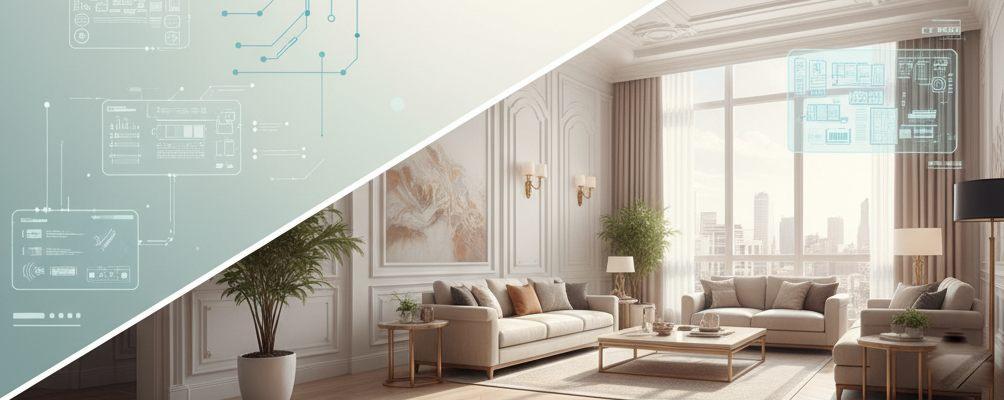
Every design project starts with a spark — a Pinterest board, a photo, a color swatch, or a whispered preference. AI helps capture and organize that inspiration instantly. Visual-recognition tools analyze uploaded images and extract key elements like color palettes, textures, and styles. Natural language tools convert short prompts — “warm Scandinavian lounge with plants” — into structured design briefs.
The result is a clear, data-backed brief that preserves the emotional intent behind the idea while adding technical clarity designers can act on.
Once the brief is set, AI can produce multiple concept variations in minutes. Instead of one static mood board, imagine getting five different directions — each with suggested furniture, finishes, and layouts. AI-driven concept generators combine trend data and the client’s preferences to propose options that are both fresh and realistic.
This rapid concept generation lets clients see diversity early, pick the direction they love, and feel confident that their preferences are being honored.
A beautiful idea can fall flat if it doesn’t physically fit the space. AI-powered space planning tools take room dimensions, window placements, circulation patterns, and usage needs and automatically create layouts that maximize function and flow. These systems understand ergonomics and circulation, ensuring furniture placement feels intuitive rather than forced.
You’ll no longer guess whether a sofa will overwhelm a room or whether a dining table will block a walkway — AI lays it out for you and provides practical, buildable options.
Perhaps the most powerful way AI turns ideas into reality is through visualization. AI rendering engines produce photorealistic images and walkthroughs from 2D plans or rough sketches. These visualizations include accurate lighting, shadows, and material finishes — giving clients a crystal-clear sense of the final space.
This “see-before-you-build” capability reduces rework, speeds approvals, and increases client satisfaction because expectations are aligned from the start.
Choosing finishes can be overwhelming. AI simplifies decisions by recommending materials that match the design intent while considering durability, cost, and sustainability. Intelligent materials databases suggest alternatives (for example, a similar-look eco-friendly tile) and show how choices will photograph and render under different lighting conditions.
Designers can experiment with finishes in real-time and instantly evaluate trade-offs between aesthetics, budget, and environmental impact.
Turning a concept into reality requires pragmatic planning. AI tools estimate costs based on selected materials and furniture and create procurement lists mapped to suppliers and lead times. Predictive cost models flag where your design might exceed budget and suggest alternatives that preserve the look while cutting costs.
This practical layer ensures your creative vision is achievable — financially and logistically.
AI enhances collaboration by providing interactive presentations and virtual walkthroughs that clients can explore on their devices. Clients can toggle finishes, swap furniture, and leave comments directly on the visuals. These interactions are tracked and fed back into the design process, tightening communication loops and deepening client trust.
When clients feel heard and can visualize changes immediately, approvals come faster and revisions drop dramatically.
AI’s role continues beyond design. Construction-ready drawings, material takeoffs, and sequencing suggestions help contractors execute the vision precisely. Some AI systems monitor progress, compare site photos to plans, and alert teams to deviations — ensuring the built space matches the original concept as closely as possible.
This continuity from digital design to physical build is where AI fully realizes its promise: turning creative vision into measurable reality.
AI is not a replacement for human creativity — it’s an enabler. Designers bring empathy, storytelling, and nuanced taste; AI brings speed, data, and repeatable accuracy. Together, they form a powerful partnership that turns client dreams into spaces that function beautifully and feel personal.
Embracing AI means amplifying your creative impact — delivering designs that are imaginative, feasible, and perfectly attuned to the people who will live in them.


 +1 949 899 7760
 +49 1525 4941805
 +91 98314 11946